
The Growth Readiness Guide: Why Your Startup's Growth Is Stalling
Most founders assume stalled growth means the product isn't working. In reality, it almost always means the system around the product was never built. This guide introduces the five alignment dimensions that determine whether your startup scales or stalls.
Great products fail because of misalignments and poor systems — not missing features.
You've built something real. You have early customers, a working MVP, and enough traction to know this isn't a fantasy. But growth is inconsistent. Pipeline is unpredictable. And every month feels like starting from scratch.
The instinct is to try more: more ads, more content, more outreach. But activity without alignment just burns runway faster. The problem isn't effort — it's that your growth engine was never designed as a system.
50%+ of founders cite marketing and GTM as real failure points
42% report "no market need" — almost always a messaging failure
22% never implemented the right marketing strategy
14% fail specifically because of ineffective marketing execution
Sources: CB Insights, Shakuro, GoingVC
Product-market fit
Product-market fit is one dimension of five.
Most founders obsess over product-market fit — and they should. But PMF alone doesn't create predictable growth. When your pricing, channels, positioning, and narrative are misaligned, growth feels fragile no matter how strong the product is. That's not a marketing problem. It's a systems problem. And it's fixable.
The breakdowns rarely live inside a single function. They live in the spaces between them — a strong product paired with misaligned pricing, a clear ICP with messaging that doesn't land, a solid channel strategy aimed at the wrong buyer.
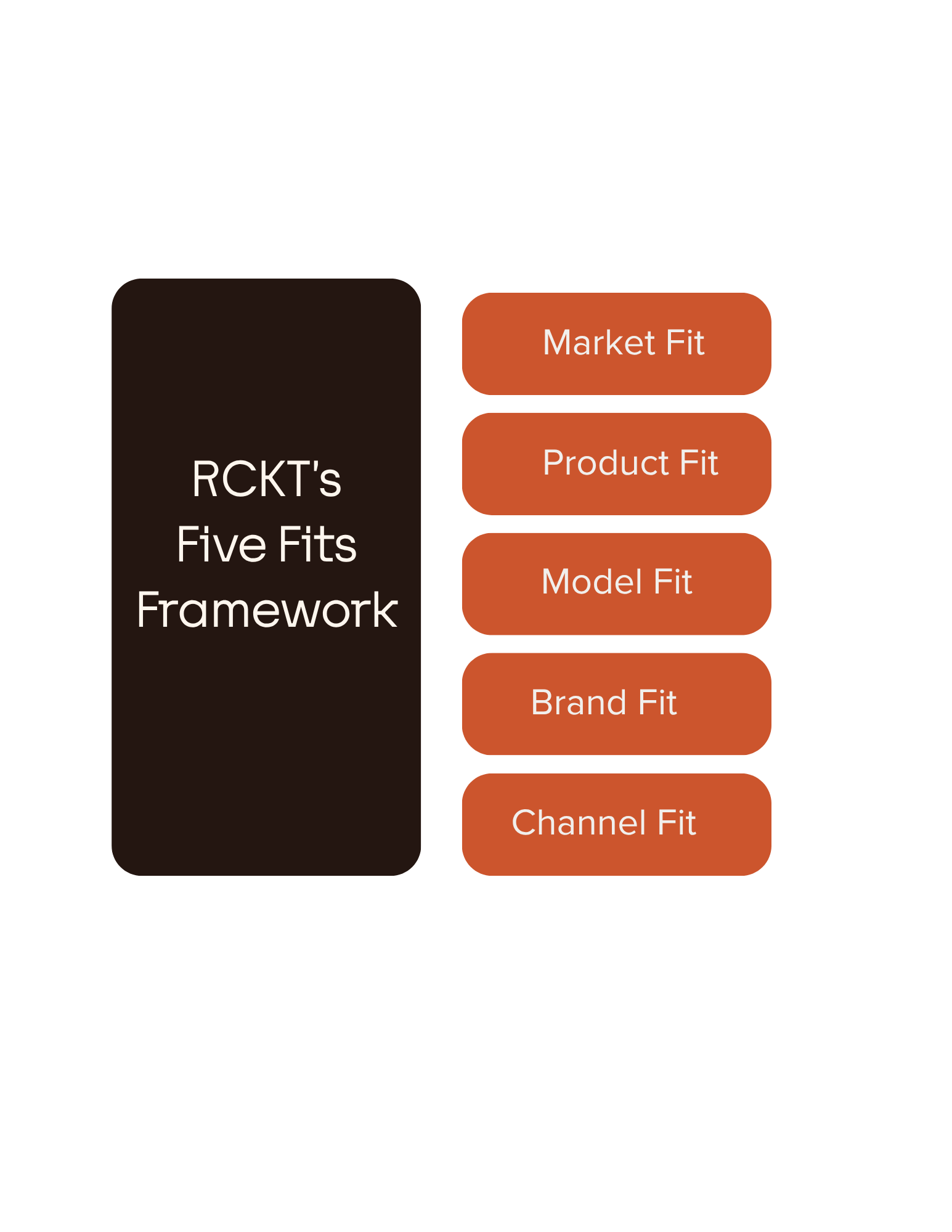
The Five Fits Framework evaluates each growth dimension individually — and, more importantly, the critical alignment between them. When they align, strategy stops being theoretical and starts guiding every campaign, conversation, and conversion.
The Five Fits: Five dimensions. One system.
Each fit represents a foundational dimension of your growth engine. Weakness in any one creates drag on the entire system. Misalignment between them is where most startups silently lose months of runway.
Fit 01: Market Fit
Do you know who you're building for — and can you prove it?
Market Fit isn't about having a target audience. It's about having a validated, prioritized Ideal Customer Profile that your entire go-to-market motion is built around. Most early-stage startups define their ICP too broadly, which means their messaging speaks to everyone and resonates with no one. True Market Fit means you know exactly who your highest-value buyer is, what language they use to describe their problem, and why they choose you over the alternatives.
Warning signs of weak Market Fit:
- You can't describe your ICP without using the word "anyone" or listing more than two industries
- Your customer interviews reveal different reasons for buying than what your marketing says
- Your best customers found you by accident, not through your marketing
Fit 02: Product Fit
Does your product solve a problem people will pay to fix?
Product Fit goes deeper than "does the product work?" It asks whether the product solves a problem your ICP actively budgets for — and whether you can articulate that value in a way a non-technical buyer immediately understands. Many engineer-led startups build exceptional technology but struggle to translate features into outcomes. The product is strong, but the bridge between capability and perceived value hasn't been built.
Warning signs of weak Product Fit:
- Prospects say "this is cool" but don't convert — the value is unclear, not absent
- You're still selling primarily to people in your personal network
- Your product description reads like a feature list, not a value proposition
Fit 03: Model Fit
Does your business model support the growth you're trying to create?
Model Fit examines whether your pricing, sales motion, and unit economics are aligned with your growth goals. A brilliant product with misaligned pricing — too low to support a sales team, too high for self-serve adoption — creates friction that no amount of marketing can overcome. Model Fit also asks whether your sales process is repeatable or still dependent on founder-led heroics.
Warning signs of weak Model Fit:
- Every deal requires the CEO to close it — there's no repeatable sales motion
- You can't explain your CAC, LTV, or payback period with confidence
- Pricing was set based on gut feel or competitor mimicry, not value alignment
Fit 04: Brand Fit
Does your market perceive you the way you need them to?
Brand Fit isn't about logos and colors. It's about whether your positioning, messaging, and market presence create the perception that drives conversion. Founders who score low here often have strong products that look like side projects — their brand doesn't match their ambition. This gap silently kills deals, especially upmarket where buyers evaluate credibility before they evaluate features.
Warning signs of weak Brand Fit:
- Prospects ghost after visiting your website — first impressions aren't converting
- You can't explain what makes you different without defaulting to features
- Your team describes the company differently depending on who you ask
Fit 05: Channel Fit
Are your growth channels producing predictable, qualified pipeline?
Channel Fit asks whether your marketing activities are integrated into a unified system — or operating as disconnected experiments. Most early-stage startups rely on one or two channels and never build a diversified acquisition engine. When that single channel stalls, growth stops. True Channel Fit means multiple channels reinforcing the same objective, with enough attribution to know what's working and scale it.
Warning signs of weak Channel Fit:
- You're dependent on one channel (usually founder-led outbound) for most pipeline
- Marketing activities run independently with no unified strategy connecting them
- You can't attribute revenue to specific marketing efforts with any confidence
Where growth really breaks: The gaps between the fits
Individual fit scores tell you where dimensions are weak. But the most expensive breakdowns happen in the alignment between them — invisible mismatches that drain runway before you realize what's wrong.
Market × ProductYour product is powerful, but it solves a problem your ICP doesn't prioritize. The feature set impresses engineers — but the buyer cares about a different outcome entirely.
Brand × ChannelYour content is consistent and your channels are active — but the messaging doesn't match the buyer's decision stage. Awareness content hits prospects who need proof. Conversion content reaches people who haven't heard of you.
Model × MarketYour pricing works for enterprise, but your ICP is mid-market SMBs. The sales cycle is too long, the deal size is too small, and neither side gets what they need. The model doesn't match the market's buying behavior.
Product × BrandThe product is technically superior, but the brand looks like a side project. Prospects evaluate credibility before they evaluate capabilities — and your first impression is losing deals the product would have won.
Quick Self-Assessment: Pressure-test your own growth engine
For each category below, honestly assess whether you can answer "yes" to these questions. The ones that make you pause are usually the ones that matter most.
Market Fit
- Can you name your top 3 ICP segments ranked by revenue potential?
- Do you know why your last 5 customers chose you — in their words, not yours?
- Could a new hire write your ICP description without asking you?
Product Fit
- Can you explain your product's value in one sentence a non-technical buyer understands?
- Are strangers buying your product — not just people in your network?
- Do customers describe your product the same way your marketing does?
Model Fit
- Can someone other than the CEO close a deal using a defined process?
- Do you know your CAC, LTV, and payback period — and do they support growth?
- Is your pricing based on validated customer value, not competitor benchmarking?
Brand Fit
- Does your website convert visitors — or just describe your product?
- Can you articulate what makes you different without listing features?
- Would a prospect take you seriously based on your brand alone?
Channel Fit
- Do you have at least 3 channels generating qualified leads consistently?
- Are your marketing efforts connected into one system, or running independently?
- Can you attribute revenue to specific marketing activities?
Where you go from here depends on where you are.
If you paused on more than a few of those questions, you're not behind — you're normal. Most Seed and Series A founders haven't had the time, resources, or outside perspective to build alignment across all five dimensions. Here's how to think about your next move.
If most answers were "no" — start with diagnostic clarity.
Before investing in execution, you need to know exactly where the breakdowns are. A structured diagnostic across all five fits will reveal the specific misalignments costing you pipeline — and sequence the fixes in the order that unlocks growth fastest.
If you had a mix of yes and no — your foundations are close. The system is what's missing.
You have traction, but it's not repeatable. The gap between where you are and predictable pipeline isn't more effort — it's an integrated growth engine that connects what's working into a system that compounds.
If most answers were "yes" — you're ready to scale what's working.
Your foundations are aligned. The next move isn't more tactics — it's a scale system that multiplies proven channels, expands into new segments, and gives you the visibility to walk into board meetings with data, not hope.
Find out exactly where your growth engine is breaking.
Take the Growth Readiness Assessment. It takes 5 minutes and gives you a scored breakdown across all five fit dimensions — with a personalized assessment of where to focus first.
Or schedule a Growth Discovery Call →
The Growth Readiness Guide is built on the RCKT Five Fits Framework — the diagnostic methodology behind 3.5× ARR growth for Y Combinator-backed startups.