Brian Halligan built HubSpot into a $30B company. His warning to founders: the game isn't starting — it's scaling. And most of you are playing it wrong.
Brian Halligan has a line he uses in his MIT scaling course that should make every early-stage founder uncomfortable: "Starting a company has never been easier. Scaling one into a durable, high-impact organization has never been harder."
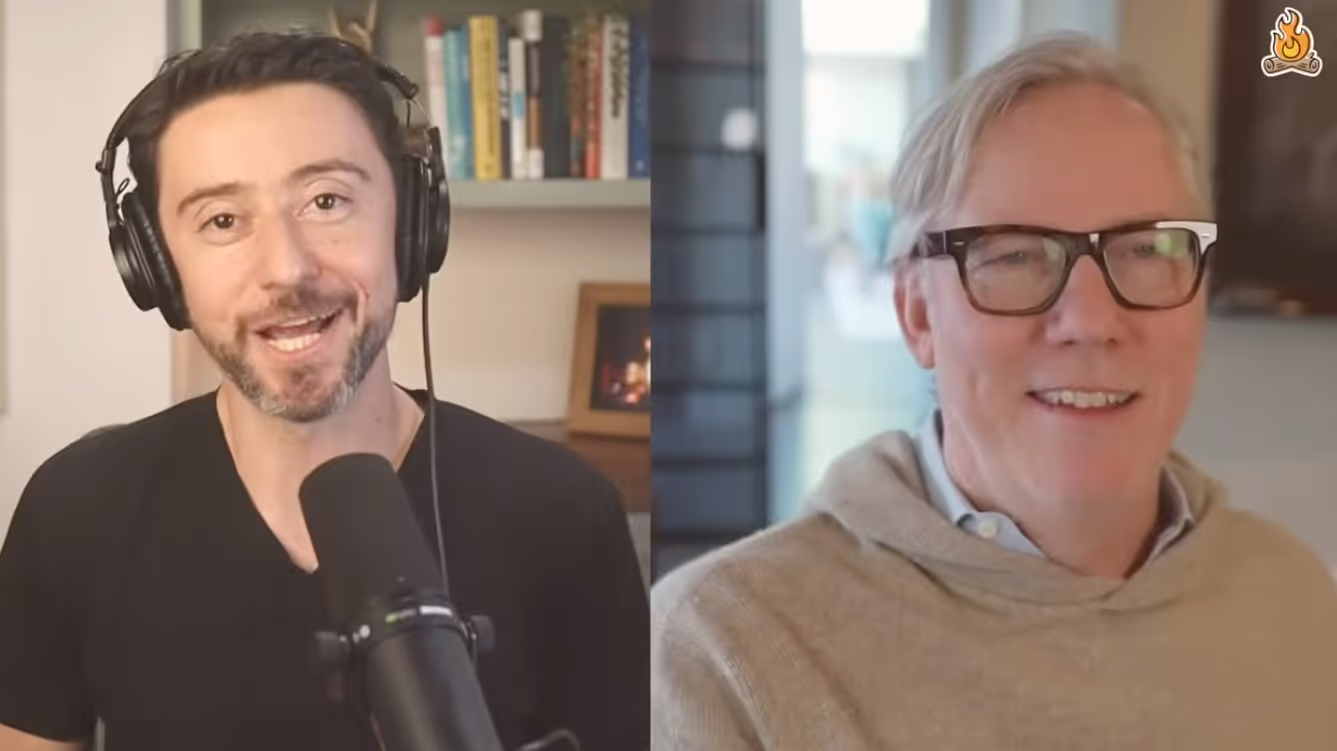
He's not being dramatic. He's describing a structural shift that most founders are sleepwalking through. In a recent conversation on Lenny Rachitsky's podcast, Halligan — who co-founded HubSpot, ran it for nearly 20 years, and now coaches Sequoia's fastest-growing CEOs — laid out exactly why the startup era we're entering will produce more companies and fewer winners than ever before.
The founders who understand this will build differently. The ones who don't will mistake early traction for a growth engine and wonder why the wheels came off at Series A.
The Flood Is the Feature
Halligan used a simple metaphor that stuck with me. When he was a kid, you walked into the corner drugstore and picked from four or five toothbrushes. By the 2000s, Amazon had 5,000. AWS made it dramatically easier to launch a software company. And now AI is about to make that jump again — orders of magnitude more companies, more products, more noise.
Every tool that makes it easier to build also makes it harder to stand out. The same AI that lets a two-person team ship a product in a weekend lets ten thousand other two-person teams do the same thing. Creation costs trending toward zero means competition trending toward infinity.
This is the paradox founders need to internalize: the ease of starting is precisely what makes scaling so brutal. Your product isn't your moat. Your ability to build a repeatable, systematic growth engine is.
The Hidden Tax on Keeping Your Options Open
Here's where Halligan said something that runs counter to how most founders think. He admitted he used to value optionality — keeping doors open, staying flexible, not committing too hard to one direction. And he now believes that mindset is a liability.
His reasoning: when the pace of execution accelerates (and AI has accelerated it dramatically), the cost of indecision compounds. Every week you spend "exploring" three positioning angles instead of committing to one is a week your competitor is deepening their hold on a specific beachhead. Halligan described moments at HubSpot where everything stalled — and when he traced it back, it was almost always because hard, one-way-door decisions were sitting on his desk, unmade.
The moment he walked through those doors — committed to a direction, killed the alternatives — the entire organization unblocked and started moving again.
For early-stage founders, this is one of the most counterintuitive lessons in scaling. You think flexibility is your advantage. In reality, it's often your bottleneck. The companies that scale aren't the ones with the most options. They're the ones that chose a lane and went deep before anyone else was ready to commit.
The Second Act Trap: Why Your Beachhead Deserves More Respect
Halligan flagged a pattern he's seeing across his portfolio that should alarm any founder who's feeling the pull of expansion: companies jumping to their second act too early.
The logic is seductive. AI lets your team move faster. You've found a beachhead market. It's working. So naturally you think — why not go after the adjacent opportunity now, while we have momentum? Halligan's answer: because your first act probably isn't as solid as you think it is, and splitting focus at this stage is how companies die of overeating rather than indigestion.
He pointed to OpenAI as a cautionary example — massive consumer traction with ChatGPT, rapid expansion into many directions, then a refocusing back to the core when Gemini emerged as a serious threat. If OpenAI has to course-correct on focus, what makes you think your 40-person startup can afford to scatter?
The uncomfortable truth is that most founders at the Seed to Series A stage haven't actually exhausted their beachhead. They've scratched the surface, seen early traction, and mistaken it for product-market fit operating at full depth. There's usually two to three times more growth available in your existing market before expansion makes strategic sense.
Annual Plans Are Dead. Quarterly Is the New Cycle.
One of the most practical shifts Halligan described is the compression of planning cycles. What used to be an annual strategic plan is now a quarterly one — and even that feels long given how fast technology shifts what's possible.
This isn't just a calendar change. It's a fundamental rethinking of how founders allocate attention and resources. Annual planning creates the illusion of certainty. Quarterly cycles force you to confront reality more often — what's working, what's not, and what just became possible that didn't exist 90 days ago.
The founders who thrive in this environment aren't the ones with the best 12-month roadmap. They're the ones who've built systems that let them learn, decide, and execute on compressed timelines — then repeat.
Distribution Is the Bottleneck Nobody Trained For
Halligan made an observation that deserves its own spotlight: "You didn't grow up doing distribution. You don't know." Most technical founders — especially in AI — are brilliant at building products and terrible at getting those products in front of buyers consistently.
And scaling is fundamentally a distribution problem. Your product can be exceptional, but if your growth depends on scattered tactics that work today and break tomorrow, you're renting traction from platforms you don't own. Halligan described the scaling journey as a learning game — the founders who learn distribution fastest win. Not the ones with the best product. Not the ones with the most funding. The fastest learners.
This is the gap that kills more promising startups than bad products ever will. You figured out how to build something people want. Now figure out how to build the engine that reliably puts it in front of them, over and over, at increasing scale.
The Shift That Matters
Halligan's core message is deceptively simple: the hard part isn't starting anymore. The hard part is building something that compounds. And that requires a fundamentally different mindset than the one that got you from zero to your first customers.
It means committing to a lane instead of preserving optionality. It means going deeper in your beachhead before chasing adjacencies. It means compressing your learning cycles and building systems — not just running experiments. And it means treating distribution as a first-class strategic problem, not something you'll figure out after the product is "ready."
This is exactly the inflection point where RCKT meets founders. Not at the idea stage, and not at the scale-up stage — at the messy middle where early traction needs to become a repeatable growth system. Because Halligan's right: the companies that win from here won't be the ones that started fastest. They'll be the ones that figured out how to scale what's already working before the window closed.