
Did you know that over 80% of digital shoppers interact with several touchpoints before buying? This complexity means funnel marketing is more important than ever for brands in 2026.
Today’s customer journey is anything but simple. To thrive, businesses must use targeted, stage-specific marketing that meets buyers where they are. Funnel marketing holds the key to navigating this landscape and unlocking sustainable growth.
In this guide, you’ll learn the fundamentals of funnel marketing, the latest trends and technologies shaping funnels in 2026, actionable strategies for every funnel stage, how to measure funnel performance, and real-world success stories.
Ready to master proven strategies and drive measurable results? Let’s dive in.
Understanding Funnel Marketing in 2026
Funnel marketing has transformed into a dynamic, multi-touch strategy at the heart of modern customer journeys. Brands now face a landscape where buyers interact with content, ads, and channels in unpredictable ways. To drive results in 2026, marketers must rethink how they structure and measure every stage of the funnel.

Defining the Marketing Funnel
The classic marketing funnel breaks down the customer journey into four main stages: Awareness, Consideration, Conversion, and Loyalty. This visual model helps marketers understand how people move from first learning about a brand to becoming loyal advocates.
In 2026, the funnel is no longer a simple linear path. Instead, it reflects a web of interactions across various digital channels. For example, 84 percent of shoppers begin their product searches on third-party platforms, not brand-owned sites. Funnel marketing requires brands to engage prospects wherever they are, from social media to search engines, ensuring no stage is overlooked.
Why Funnel Marketing Still Matters
Despite the complexity of today’s buying environment, funnel marketing remains crucial for organizing campaigns and allocating resources efficiently. Funnels serve as a roadmap, guiding brands in both lead generation and nurturing.
By connecting campaigns, content, and channels, funnel marketing delivers measurable ROI. Without a structured funnel, marketing efforts become fragmented and harder to measure. Brands that lack a funnel approach often struggle to move prospects smoothly from awareness to purchase, losing out to competitors who take a more holistic view.
Key Funnel Models and Frameworks
Several models guide funnel marketing, each with strengths for different goals. The AIDA model (Attention, Interest, Desire, Action) is a timeless framework, while TOFU-MOFU-BOFU (Top, Middle, Bottom of Funnel) breaks content into stages. Modern full-funnel strategies focus on omnichannel touchpoints, adapting to fragmented buyer journeys.
Micro-funnels are gaining popularity in 2026, targeting niche segments with tailored messaging. For example, a B2B SaaS company might nurture leads with webinars and demos, while an eCommerce brand uses retargeting and shoppable content. To dive deeper into frameworks shaping this evolution, explore growth funnel frameworks for practical insights.
Funnel Marketing vs. Sales Funnel
While both concepts sound similar, funnel marketing covers the full spectrum from awareness to loyalty, whereas the sales funnel zeroes in on conversion and closing deals. The overlap happens in the middle and bottom stages, where nurturing turns into direct selling.
For instance, B2B SaaS companies nurture leads over weeks with educational content before a sales handoff, while eCommerce brands may drive direct purchases after brief consideration. Integrating both funnels ensures a seamless customer experience and requires close alignment between marketing and sales teams for maximum impact.
Stages of the Modern Marketing Funnel
Understanding the stages of the modern marketing funnel is essential for brands aiming to thrive in 2026. Each stage serves a unique purpose and demands specific strategies to guide customers from first touch to loyal advocacy. Let’s break down each phase and see how funnel marketing adapts to today’s complex journeys.

Awareness: Capturing Attention in a Crowded Market
The awareness stage is where potential customers first encounter your brand. The main goal at this point is visibility. With so many brands competing for attention, funnel marketing relies on digital channels like streaming TV, social media, display ads, and audio ads to reach audiences.
Did you know 84% of product searches now start on non-brand digital platforms? This makes brand recognition and recall more important than ever. Examples include viral campaigns, influencer marketing, and branded content, all designed to spark interest and keep your brand top of mind. For a deeper dive into these stages, explore the Stages of the marketing funnel.
Consideration: Building Trust and Differentiation
Once you capture attention, the consideration stage focuses on building trust and setting your brand apart. Here, funnel marketing leverages customer reviews, testimonials, webinars, and educational content to address questions and pain points.
Customers actively compare options, so providing value is key. For B2B SaaS, case studies work well. For eCommerce, comparison guides help shoppers make informed decisions. In 2026, interactive and personalized content—like quizzes or tailored recommendations—are essential for nurturing interest and guiding prospects closer to conversion.
Conversion: Turning Interest into Action
The conversion stage is where funnel marketing turns interest into measurable results. Key performance indicators include conversion rate optimization (CRO), purchase rates, and lead signups.
Effective strategies involve optimized landing pages, clear calls-to-action, retargeting campaigns, and trust signals such as reviews or guarantees. Reducing friction is vital, so a seamless mobile experience and social proof matter. Personalized offers based on browsing behavior can nudge users to complete a purchase or sign up, ensuring the journey from prospect to customer is as smooth as possible.
Loyalty: Creating Advocates and Repeat Buyers
Loyalty is what transforms a one-time buyer into a repeat customer and brand advocate. Funnel marketing at this stage uses tactics like loyalty programs, email nurturing, and exclusive offers to keep customers engaged.
Research shows loyal customers are five times more likely to repurchase. Referral programs and community-building initiatives, such as private groups or events, foster a sense of belonging. Post-purchase engagement—like follow-up emails and responsive support—helps build lasting relationships and boosts lifetime value.
Adapting Funnel Stages for Non-Linear Journeys
Today’s customer journey is rarely linear. People move back and forth between stages, influenced by omnichannel touchpoints and cross-device behavior. Funnel marketing must be dynamic and data-driven to keep up.
Brands need strategies for re-engaging lapsed leads, nurturing across multiple stages, and retargeting users on various platforms. For example, retargeting someone who interacted with your brand on mobile and later on desktop ensures consistent messaging. Mapping these complex journeys requires flexible funnel models and real-time analytics to optimize every touchpoint.
Funnel Marketing Strategies for Success in 2026
As digital landscapes shift, funnel marketing strategies are evolving to meet the expectations of today’s connected consumers. Brands now need nimble, data-driven approaches to stay ahead. Let’s explore the essential tactics powering high-performance funnels in 2026.

Personalization and Segmentation at Scale
Personalization is now the heart of funnel marketing. With AI-driven segmentation, brands tailor messaging for each prospect at every funnel stage. This means smarter targeting and more relevant offers, increasing engagement and conversions.
Modern platforms use predictive analytics to group audiences by behavior, interests, and purchase signals. For example:
- Dynamic content adapts to each visitor’s journey.
- Personalized email sequences nurture leads with timely, relevant information.
- Customer data platforms unify profiles for precise targeting.
Brands report higher open rates and improved ROI when funnel marketing leverages segmentation and personalization. In 2026, personalization at scale is not a luxury, but a necessity.
Omnichannel Integration and Attribution
Today’s buyers move seamlessly between devices and channels, so funnel marketing must deliver a unified experience. Omnichannel integration ensures your message is consistent whether prospects engage on social media, email, or paid ads.
Multi-touch attribution models now track every interaction across the funnel, revealing which channels drive results. For instance:
- Integrated campaigns span social, search, and email for cohesive storytelling.
- Unified reporting tools make measurement transparent.
- Attribution data guides resource allocation for maximum impact.
Amazon’s research shows customers expect brands to meet them everywhere, making omnichannel funnel marketing essential in 2026.
Content Strategies for Each Funnel Stage
Content fuels every stage of the funnel marketing process. In the awareness phase, blogs and short videos capture attention. As leads progress, webinars and guides address deeper questions. Demos and free trials help seal conversions.
Emerging content trends in 2026 include:
- Interactive product demos and live Q&A sessions.
- Shoppable content for instant action.
- Educational resources tailored to audience needs.
Repurposing content across funnel stages extends its lifespan and strengthens your overall funnel marketing approach.
Leveraging Automation and AI in Funnel Marketing
AI and automation are transforming funnel marketing by streamlining repetitive tasks and enabling timely, relevant communication. Marketing automation platforms now handle complex drip campaigns, lead scoring, and even chatbot-driven qualification.
Key benefits include:
- Automated nurturing sequences that adapt to user behavior.
- Chatbots answering questions and qualifying leads 24/7.
- AI-powered recommendations for next-best actions.
Industry data confirms that automation in funnel marketing boosts efficiency and ROI, but the human touch remains vital for building trust and loyalty.
Data-Driven Optimization and Experimentation
Continuous improvement is at the core of successful funnel marketing. Analytics platforms highlight bottlenecks and reveal opportunities for optimization. Brands now rely on A/B testing and multivariate experiments to refine every funnel stage.
Common tests include:
- Comparing CTAs and landing page designs.
- Adjusting offer types based on performance.
- Monitoring real-time dashboards for instant feedback.
For deeper insights, check out these funnel optimization strategies. Funnels thrive when optimization becomes a habit, not a one-time effort.
Customer Experience and Trust as Funnel Accelerators
Customer experience is a powerful accelerator in funnel marketing. Positive interactions build trust and move prospects through the funnel faster. Trust signals like reviews, transparent policies, and responsive support are more important than ever.
Winning tactics include:
- Proactive onboarding for SaaS users.
- Post-purchase follow-ups for eCommerce.
- Community-building efforts to foster brand advocacy.
Research shows that investing in customer experience within funnel marketing increases loyalty and repeat purchases.
Emerging Trends: Voice, Video, and Interactive Funnels
Funnel marketing is rapidly adapting to new technologies. Voice search and conversational marketing are growing, while video—especially short-form and live—dominates the upper funnel.
Innovative trends to watch in 2026:
- Interactive quizzes personalize recommendations.
- AR product demos immerse shoppers in the experience.
- Shoppable livestreams turn viewers into buyers instantly.
Engagement rates for these interactive formats are surging, signaling that funnel marketing will continue to evolve as consumer tech advances.
Measuring Funnel Performance and ROI
In 2026, measuring funnel marketing performance is more complex and essential than ever. Brands must go beyond surface-level metrics and dive deep into the data to understand each funnel stage’s contribution to growth. With evolving technologies and multi-touch customer journeys, accurate measurement unlocks the insights needed to optimize strategies and drive sustainable results.
Key Funnel Metrics and KPIs for 2026
Understanding which numbers matter most is crucial for effective funnel marketing. The core metrics include customer acquisition cost (CAC), lifetime value (LTV), conversion rates, engagement rates, and churn. For each funnel stage, brands should track specific KPIs such as lead-to-customer rate in the consideration phase or repeat purchase frequency in the loyalty stage.
- CAC: How much you spend to acquire each customer.
- LTV: The total revenue a customer generates over time.
- Conversion rate: The percentage of prospects taking the desired action.
- Engagement rate: Interactions with your content or campaigns.
- Churn: The rate at which customers stop buying or engaging.
According to AI's Impact on Marketing Funnels, tracking both macro and micro conversions is vital for funnel marketing success. Comparing your spend and outcomes with industry peers helps set realistic goals and spot improvement areas.
Attribution Models and Funnel Insights
Attribution models are the backbone of accurate funnel marketing analysis. First-touch, last-touch, and multi-touch attribution each offer unique perspectives on which channels and campaigns drive results. In 2026, data-driven attribution is becoming the standard, allowing marketers to allocate budgets more effectively and understand the true impact of every interaction.
For example, mapping channel influence across the funnel reveals which touchpoints influence awareness, consideration, or conversion. Tools for attribution analysis make it easier to visualize this journey and adjust strategies in real time.
By adopting advanced attribution models, marketers can pinpoint what works and confidently invest in high-performing tactics. This approach ensures funnel marketing is both efficient and measurable.
Understanding Channel Interactions and Synergy
No single channel operates in isolation within funnel marketing. Each platform, from email to paid social, plays a unique role at different funnel stages. Integrated campaigns often outperform siloed efforts, as they create a seamless experience for the customer.
Consider a scenario where a user clicks a social ad, attends a webinar, and then receives a personalized email. This synergy between channels amplifies funnel marketing effectiveness and increases conversion rates.
Omnichannel metrics reveal the true impact of these interactions, helping marketers identify which combinations drive the best results. Doubling down on high-performing channel mixes can accelerate growth and improve ROI.
Benchmarks, Peer Comparisons, and Continuous Improvement
Benchmarking is vital for funnel marketing optimization. Comparing your funnel metrics to industry peers highlights opportunities and exposes gaps. Analytics platforms now offer robust tools to track performance by channel, industry, or customer segment.
- Compare conversion rates across platforms.
- Monitor spend and outcomes against similar brands.
- Identify trends in repeat purchase or churn.
Amazon Ads emphasizes the importance of peer comparison for informed decision-making. Agility is key, so use real-time dashboards to iterate and refine your funnel marketing strategies. Continuous improvement ensures your brand stays ahead in a competitive landscape.
Real-World Examples and Case Studies
Funnel marketing comes alive through real-world examples, showing how brands adapt strategies for growth. Let’s explore how leading companies use funnel marketing to drive results across B2B SaaS, eCommerce, and beyond.
Full-Funnel Strategy in Action: B2B SaaS
A B2B SaaS company demonstrates the power of funnel marketing by guiding prospects from awareness to loyalty. Their journey starts with educational webinars and thought leadership content that spark initial interest.
- Targeted email sequences nurture leads mid-funnel, offering personalized demos and in-depth product guides.
- Conversion tactics include free trial offers, tailored onboarding, and proactive support to boost signups.
- For loyalty, customer success check-ins and referral incentives create advocates who return and refer others.
With this approach, the SaaS brand sees triple-digit lead growth and annual recurring revenue expansion. By actively optimizing each stage, their funnel marketing strategy keeps prospects engaged and moving forward.
Full-Funnel Strategy in Action: eCommerce Brand
An eCommerce brand leverages funnel marketing to attract, convert, and retain shoppers. Awareness kicks off with influencer campaigns and paid social ads that put products front and center.
- Consideration deepens through comparison guides, authentic customer reviews, and dynamic retargeting ads.
- Conversion is driven by limited-time offers, personalized product recommendations, and cart abandonment reminders.
- Loyalty programs reward repeat buyers with points, exclusive access, and early product releases.
This data-driven approach increases repeat purchase rates and boosts customer lifetime value. For more insights, explore the latest Sales Funnel Statistics 2025 to benchmark your funnel marketing efforts.
Lessons from Leading Brands and Platforms
Amazon’s funnel marketing solutions showcase how integrated campaigns drive measurable results. Their approach combines sponsored search, display, and video ads for top-of-funnel brand lift, while loyalty initiatives deepen post-purchase engagement.
- Campaign synergy is achieved by aligning content, timing, and targeting across channels.
- Case studies reveal how orchestrated touchpoints maximize ROI and accelerate buyer journeys.
- Leading brands use real-time analytics to identify high-performing tactics and double down on what works.
Brands embracing this holistic approach to funnel marketing consistently see uplift in sales and customer advocacy. For a deeper dive into how AI is transforming funnel performance, review AI-Driven Sales Funnel Optimization.
How Structured Growth Frameworks Drive Funnel Success
Early-stage B2B SaaS startups often struggle with fragmented marketing. The RCKT Growth Framework brings clarity by unifying campaigns, content, and channels into a single funnel marketing system.
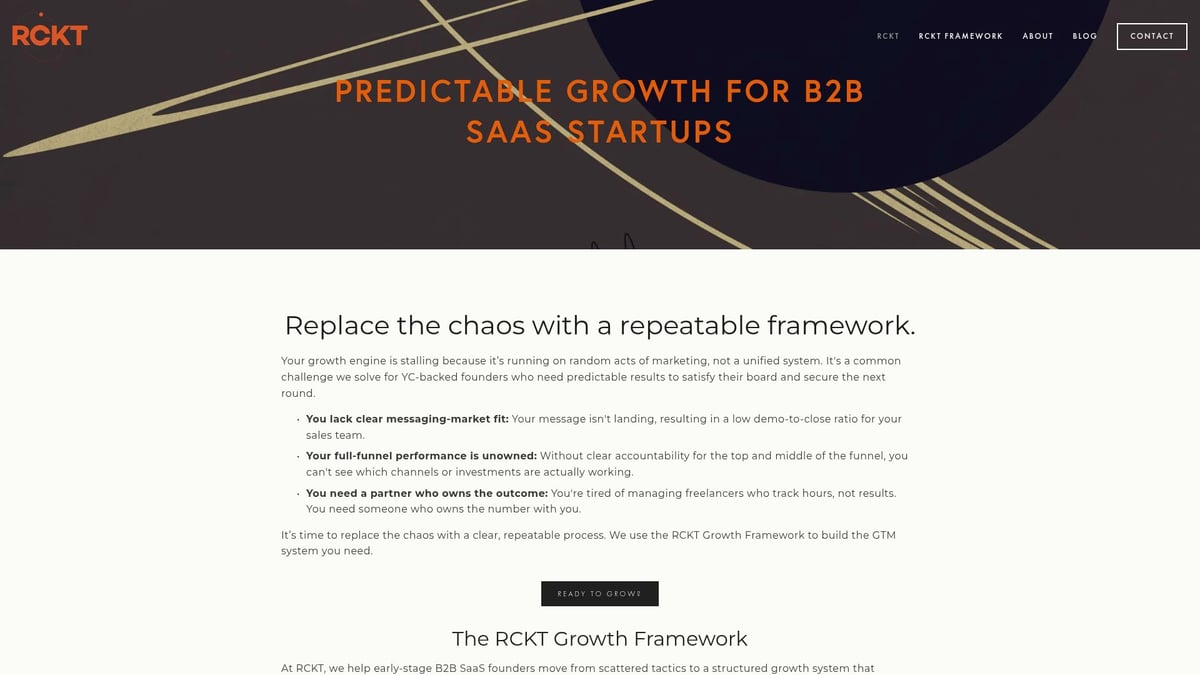
- Data loops and dashboards enable founders to track progress and optimize in real time.
- Integration of sales and marketing ensures everyone owns outcomes and works toward shared goals.
- Examples show measurable lead growth and revenue expansion from a structured funnel.
Ownership, continuous optimization, and a clear framework are vital for sustainable funnel marketing success. With the right system, even lean teams achieve predictable, scalable growth.
If you’re ready to take your funnel marketing from theory to action, I hope this guide gave you some practical steps to start. We’ve seen how a unified, data-driven approach can turn scattered efforts into real, measurable growth—especially for SaaS founders juggling a million things at once. If you want to see how a structured framework can simplify your marketing, drive more leads, and give you confidence in every stage of the funnel, I recommend you Learn more about RCKT's Growth Packages. It’s a great next step to building the kind of predictable, scalable growth engine we talked about here.