

Competition in 2026 is fiercer than ever, making it crucial for businesses to truly understand what drives their customers. JTBD, which stands for Jobs To Be Done, has become the gold standard for unlocking powerful customer insights that fuel innovation and growth.
By mastering JTBD, companies can predict customer needs, stay ahead of the competition, and design products that people genuinely want. This guide will walk you through the fundamentals of JTBD, the latest frameworks, practical steps for implementation, and the trends shaping 2026.
Get ready to discover the definitive approach for using JTBD to extract actionable insights and accelerate your business growth.
Understanding JTBD: Foundations and Evolution
Understanding why JTBD is reshaping the way companies uncover customer needs starts with its foundation. The JTBD approach digs beneath surface behaviors to reveal the deeper motivations that drive people to choose one product or service over another.

The Origins and Core Principles of JTBD
JTBD stands for Jobs To Be Done, a framework designed to uncover the real tasks, goals, and motivations behind customer decisions. Rather than focusing on what customers are buying, JTBD asks, "What are they trying to accomplish?" This shift in perspective is crucial for businesses aiming to create solutions that truly matter.
The concept gained momentum with Clayton Christensen’s famous “Milkshake Study.” Researchers discovered that commuters were buying milkshakes not just for taste, but to make their morning drive more engaging and filling. This insight led to a new way of thinking: people “hire” products to do specific jobs in their lives. Over time, JTBD evolved from a broad idea into a practical, trigger-based methodology.
Traditional personas rely on demographics, like age or income, but JTBD focuses on progress and context. For example, a drill is not just a tool for making holes; it's a means to display art or express personal taste. This reframing opens up new solution spaces, helping teams innovate beyond obvious features.
Triggers play a pivotal role in JTBD. These are the moments or unmet needs that prompt action, such as a sudden problem or a life change. JTBD uncovers not only functional requirements but also emotional and social drivers. Companies that leverage JTBD often innovate more effectively, as they address the full spectrum of customer motivation.
Compared to conventional methods, JTBD offers a more actionable, data-driven approach. In fact, leading UX and product teams are rapidly adopting JTBD, as highlighted in this JTBD framework deep dive, to fuel innovation and stay ahead in competitive markets.
JTBD in 2026: Why It Matters More Than Ever
As we look toward 2026, JTBD is becoming even more essential. With markets saturated and products increasingly similar, understanding the true job a customer needs to get done is the key to standing out. The explosion of digital channels and AI has made customer journeys more fragmented and complex than ever.
Customers now expect experiences tailored to their desired outcomes, not just their demographics. JTBD bridges the gap between raw data, empathy, and strategic decision-making. It helps companies connect the dots, ensuring products align with what customers truly value.
For example, leading SaaS companies use JTBD to identify and prioritize jobs that drive the most significant lead growth and annual recurring revenue expansion. By focusing on the underlying motivations and outcomes, they consistently deliver products and services that delight users and outperform competitors.
JTBD is not just a framework; in 2026, it is a competitive advantage. Companies that master JTBD will be best positioned to anticipate needs, personalize experiences, and create lasting value in an ever-changing business landscape.
The Anatomy of a JTBD: Triggers, Context, and Outcomes
Understanding the anatomy of a JTBD is crucial for any business aiming to decode what truly drives customer choices. By focusing on triggers, context, and outcomes, companies can move beyond surface-level observations and uncover the real reasons behind customer actions.

Identifying Triggers and Customer Contexts
At the heart of every JTBD lies a trigger—an event or situation that sparks the customer's journey. Triggers can be as simple as feeling hungry or as complex as moving to a new city. They create urgency and motivate people to seek solutions.
There are two main types of triggers in JTBD:
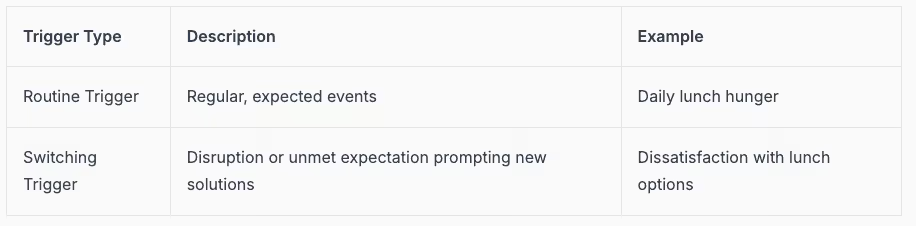
Imagine someone deciding what to eat for lunch. If hunger is the trigger, the JTBD may be to quickly satisfy their appetite. But if it is a special occasion, the job shifts—perhaps to impress a colleague or celebrate, changing the solution entirely. This demonstrates how context shapes the JTBD and why a one-size-fits-all product rarely succeeds.
Habits also play a significant role in JTBD. Most customers stick with familiar solutions until a switching trigger disrupts their routine. This is why understanding not just what people do, but why they do it, is essential. According to recent SaaS industry data, customer churn often spikes after key triggers like service outages or unmet expectations, reflecting the power of context in JTBD.
Mapping these triggers and contexts helps organizations predict when and why customers might switch. As Jobs to Be Done: A Useful Framework for Driving Customer Value explains, identifying these moments allows companies to tailor their offerings more precisely to real customer needs.
Outcomes: Needs vs. Wants and the Bigger Context
JTBD is not just about solving functional problems—it also addresses emotional and social goals. Distinguishing between needs and wants is vital for innovation.

Consider the classic example: a customer does not want a drill, they want art on the wall. But looking deeper, they may want to express their taste or avoid damaging their apartment. This is where leveling up to the bigger context reveals unmet desires that traditional approaches miss.
Companies like 3M and Samsung have excelled by focusing on the bigger context. 3M’s mounting tape and Samsung’s Frame TV both address the same JTBD—displaying art—without relying on the conventional drill. These innovations show how understanding both needs and wants leads to solution-agnostic breakthroughs.
Continuous innovation in JTBD comes from revisiting the context regularly. As markets evolve, so do the jobs customers are trying to accomplish. By keeping an eye on both functional and emotional outcomes, businesses can stay ahead and remain relevant.
Implementing JTBD in 2026: A Step-by-Step Guide
Unlocking the full potential of JTBD in 2026 requires a structured, actionable approach. Whether you are new to Jobs To Be Done or looking to refine your process, this step-by-step guide breaks down practical methods to gather insights, map journeys, prioritize jobs, and design solutions that drive growth.

Step 1: Gathering Raw Customer Insights
Every effective JTBD process starts with the right data. Begin by conducting in-depth customer interviews. Use open-ended questions such as, "What led you to seek a new solution?" or "Describe a time when you struggled with this task." These help uncover the underlying jobs, triggers, and desired outcomes.
Observation is equally powerful. Methods like ethnographic studies, diary studies, and contextual inquiry allow you to see how customers interact with products in real-life situations. For digital products, leverage analytics, heatmaps, and AI-driven tools to identify behavior patterns and friction points.
For example, leading teams often blend qualitative interviews with digital analytics, enabling a holistic view of customer motivations. Since 2024, remote research and digital ethnography have surged, making it easier to reach global audiences and collect richer JTBD insights.
Do not underestimate the value of triangulating data sources. Combining direct quotes, observed actions, and digital footprints creates a robust foundation for the next steps in your JTBD journey.
Step 2: Mapping the Customer Journey Through JTBD
Once you have raw insights, the next step is to structure them into actionable JTBD statements. Use this format:When [trigger], I want to [job], so I can [desired outcome].
This approach clarifies what truly drives customer behavior.
Visualizing the customer journey is essential. Map out jobs, triggers, and outcomes across every touchpoint, from discovery to onboarding and retention. Identify pain points and moments where customer needs are unmet.
For a SaaS platform, mapping the onboarding journey using JTBD can reveal friction that blocks activation. Teams who excel here often rely on collaborative journey mapping sessions, sticky notes, and digital whiteboards.
Mapping journeys not only improves activation and retention rates but also aligns your team around real customer needs. For a deeper dive into effective journey mapping, see Mapping the customer journey.
Step 3: Prioritizing Jobs for Innovation and Growth
Not all jobs are created equal. To maximize JTBD-driven innovation, evaluate jobs based on how frequently they occur, how important they are to customers, and how satisfied customers are with current solutions.
Frameworks like the Customer Forces Canvas and opportunity scoring help summarize and prioritize insights. Outcome-driven innovation (ODI) is another method, focusing on where the biggest gaps and opportunities lie.
Here is a simple table to help compare jobs:

Product teams often use these criteria to decide which jobs to tackle first. For instance, B2B SaaS companies benchmark job prioritization to ensure they are solving the most valuable problems, leading to stronger product-market fit and growth.
By focusing on the most impactful jobs, JTBD empowers organizations to allocate resources where they will drive the most innovation and customer value.
Step 4: Designing Solutions Aligned with JTBD
With prioritized jobs in hand, it is time to ideate and prototype solutions. Start by generating concepts that address both the functional and emotional aspects of each job. Involve cross-functional teams in brainstorming sessions to ensure diverse perspectives.
Rapid prototyping and user testing are critical. Bring your ideas to users early and often, using their feedback to refine both the solution and the messaging. JTBD should also guide your marketing and onboarding content, making sure you speak directly to the job the customer wants to achieve, not just the features of your product.
For example, A/B testing JTBD-driven messaging often results in higher conversion rates. Leading companies let JTBD inform their product roadmap and go-to-market strategy, ensuring every touchpoint resonates with what customers actually want to accomplish.
When you align solutions to JTBD, you are not just building better products—you are creating experiences that anticipate needs and foster loyalty.
JTBD in Action: Case Studies and Best Practices
Understanding how JTBD works in real businesses brings its power to life. By exploring detailed examples and uncovering common mistakes, you can see why JTBD is a game changer for innovation and growth.

Real-World Applications Across Industries
JTBD has reshaped how leading brands in SaaS, consumer goods, and hardware approach customer needs. Take Intercom and Basecamp, for example. Both have used JTBD to rethink onboarding, feature design, and product messaging, resulting in more relevant solutions and higher user retention.
The iconic "milkshake study" illustrates how a fast-food chain used JTBD to discover that morning commuters bought milkshakes not just for taste, but to make a long drive more enjoyable. This insight led to product tweaks that boosted sales. Similarly, 3M’s innovation process focuses on uncovering the job behind the need, such as mounting art without damaging walls. Their solution-agnostic approach led to products like Command Strips, which address both functional and emotional jobs.
In hardware, the classic example is a customer buying a drill not for the tool, but for the art they want to hang. Samsung’s Frame TV takes this further, combining technology with home decor to meet the bigger job of expressing personal style. These cases show how JTBD reframes the solution space, leading to breakthrough ideas.
A recent industry report showed that companies using JTBD are 50% more likely to launch successful products compared to those relying on traditional persona-based methods. For a deeper dive into practical JTBD implementation, check out this Jobs To Be Done: An Innovative Needs Assessment Method.

Common Pitfalls and How to Avoid Them
Many teams stumble when adopting JTBD. One frequent pitfall is focusing solely on functional jobs while ignoring emotional or social drivers. For example, a product team might improve a drill’s performance, but miss that customers actually seek a stylish way to decorate their space. This narrow focus can cause missed opportunities for innovation.
Another common mistake is solution bias, where teams define the job as using their product, not the real progress customers seek. Inadequate customer research, like relying only on surveys or analytics, can lead to shallow insights. It is also risky to let JTBD research go stale as markets shift. Companies that do not update their frameworks may overlook emerging needs or new triggers.
To avoid these traps, it is vital to:
- Level up to the bigger context of the job, not just the immediate need
- Use mixed research methods, including interviews and observation
- Regularly revisit and update JTBD insights
A compelling case study shows how Stepstone scaled JTBD for deeper customer focus and avoided these pitfalls, as detailed in Jobs-to-be-Done at Scale: Disrupting the Status Quo with Customer Focus.
By learning from these real-world JTBD stories and common missteps, you can build a more resilient strategy that keeps your business ahead of the curve.
The Future of JTBD: Trends and Predictions for 2026
As organizations look ahead to 2026, the trajectory of JTBD is clear: it is no longer just a framework, but a critical driver of business strategy and innovation. Companies that embrace JTBD will find themselves at the forefront of customer-centric growth, leveraging deep insights to outpace the competition.
Emerging Trends in JTBD Application
JTBD is rapidly evolving thanks to advances in technology and shifts in consumer expectations. The integration of AI and automation is transforming how organizations uncover customer jobs, enabling detection of patterns and triggers at scale. Machine learning tools analyze large volumes of behavioral data, revealing hidden JTBD opportunities that would be impossible to spot manually.
Personalization is another major trend. Businesses now use real-time job detection to deliver hyper-segmented experiences, tailoring solutions to the unique context and motivation of each customer. JTBD is being combined with advanced analytics, allowing teams to map customer journeys, jobs, and friction points automatically. This seamless integration ensures that JTBD insights drive not just product development, but also marketing, support, and onboarding.
Cross-functional adoption is accelerating. JTBD is becoming a shared language across product, marketing, and customer experience teams, breaking down silos and aligning strategy. For example, AI-driven SaaS platforms now offer automated JTBD mapping, empowering teams to act on insights faster than ever before.
If you want a deeper dive into practical JTBD applications and how they are shaping business decisions, check out this Jobs to Be Done Framework for Business: Simple JTBD Guide.
JTBD as a Strategic Imperative
The shift from product-centric to outcome-centric organizations is reshaping business priorities in 2026. JTBD is at the heart of this transformation, enabling companies to focus on the real progress customers seek, not just the features they use. This mindset delivers sustainable competitive advantage, as businesses continually adjust to evolving jobs and contexts.
Industry forecasts highlight that companies systematically applying JTBD processes are outperforming their peers in customer satisfaction and revenue growth. JTBD is predicted to become a core competency for high-growth organizations, where every team member understands the customer’s job and aligns their work accordingly.
Predictions for 2026 include:
- Widespread adoption of JTBD-powered analytics tools.
- Greater investment in continuous JTBD research and validation.
- JTBD embedded into product roadmaps, marketing strategies, and customer success programs.
A key takeaway is that product-market fit alone is no longer enough to thrive. As discussed in this article on Product-market fit strategies, JTBD is essential for achieving true alignment with customer needs and unlocking sustained growth.
By making JTBD a strategic imperative, companies will lead the next wave of customer-centric innovation, setting the standard for excellence in 2026 and beyond.
If you’re excited to put JTBD thinking into action and want a proven system to guide your growth, you’re not alone—the most successful SaaS founders are ditching disorganized marketing for a more unified, results-driven approach. We’ve walked through how JTBD uncovers what your customers truly need and how it powers sustainable growth in 2026. If you’re ready to build clarity, drive predictable results, and feel confident about every campaign, you can take the next step by exploring Learn more about RCKT's Growth Packages. It’s a practical way to turn these insights into real outcomes for your business.